Most food scraps end up in landfills, where they produce methane — a greenhouse gas far more potent than CO₂. Here's what separating organic waste actually does, and why it matters.
Most people in the U.S. throw food scraps into the general trash without a second thought. They take the bin out, the scraps disappear, and that's the end of it.
But what happens after the truck drives away is worth understanding. Once in a landfill, food undergoes a chemical process that produces methane — one of the most potent greenhouse gases. Separating organic waste is one of the more straightforward things any household can do to reduce its environmental impact. This article explains the science behind what actually happens when food scraps reach a landfill versus a composting system.
What Happens to Food Scraps in a Landfill
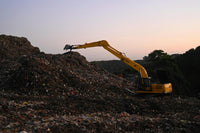
When organic material — food scraps, vegetable peels, coffee grounds, leftovers — gets buried in a landfill alongside other trash, it decomposes without access to oxygen. This anaerobic breakdown produces methane gas (CH₄). According to the EPA, methane is at least 28 times more effective than CO₂ at trapping heat in the atmosphere over a 100-year period, based on the latest IPCC assessments.
of fugitive methane from U.S. municipal solid waste landfills comes specifically from food waste, per the EPA's 2023 report
Municipal solid waste landfills are the third-largest source of human-related methane emissions in the United States
of all food waste generated in the U.S. gets composted — the rest is largely landfilled
Sources: EPA — Quantifying Methane Emissions from Landfilled Food Waste (2023) · EPA — Sustainable Management of Food
Per EPA data, food makes up about 24% of what goes into U.S. landfills — making it the single largest category of landfilled material. When a banana peel or leftover pasta goes into a regular trash bin, it very likely ends up producing methane underground for years.

What Happens When Organic Waste Goes Somewhere Better
Composting is the alternative pathway, and the difference in outcome is significant.
When organic waste is composted aerobically — with oxygen — it breaks down into a stable, carbon-rich soil amendment. According to the EPA's Benefits of Using Compost report (2025), compost applied to soil:
- Returns nitrogen, phosphorus, potassium, and trace minerals to the soil, instead of losing these nutrients in a landfill
- Improves soil water retention, reducing irrigation needs and helping soil resist drought
- Reduces erosion and runoff by improving soil structure
- Supports microbial diversity in soil, essential to plant health and long-term agricultural productivity
- Reduces the need for synthetic chemical fertilizers, whose production is energy-intensive and fossil-fuel dependent
Composting also keeps methane out of the atmosphere. When food breaks down aerobically in a compost system, it produces CO₂ rather than methane, and much of the carbon becomes sequestered in the soil rather than released.
Diverting organic waste from landfills to composting and anaerobic digestion systems could reduce landfill methane emissions by up to 80%, with an annual global mitigation potential of 760 million tonnes of CO₂.
Nature Climate Change, 2025Why the Nutrients in Your Kitchen Scraps Actually Matter
Food scraps are easy to treat as garbage once a meal is finished. From a soil perspective, though, they're still full of usable nutrients.
The nitrogen in vegetable trimmings, phosphorus in eggshells, and potassium in fruit peels are elements originally drawn from soil — and composting returns them to it. When they go to a landfill instead, that nutrient cycle is broken.
| In a Landfill | In a Compost System |
|---|---|
| Decomposes without oxygen → produces methane (CH₄) | Decomposes with oxygen → produces CO₂, carbon sequestered in soil |
| Nutrients locked inside, unusable | Nitrogen, phosphorus, potassium returned to soil |
| Contributes to methane emissions for years | Reduces need for synthetic fertilizers |
| Soil depletion continues; more synthetic inputs needed | Soil water retention improves; less irrigation needed |
The NRDC's Composting 101 Guide explains that compost contains the three primary nutrients needed by crops — nitrogen, phosphorus, and potassium — alongside calcium, magnesium, iron, and zinc. Compost also increases soil's ability to retain water, reducing irrigation needs, which accounts for about 80% of U.S. water use according to the EPA.
Why Most People Still Don't Separate Organic Waste
Knowing the environmental case for organic waste separation and actually doing it consistently don't always align.
A 2022 study published in Waste Management found that the primary inhibiting factors are concerns about odor, messiness, and the perceived unpleasantness of handling food waste. These are specific sensory and practical friction points — powerful enough to stop people from changing their waste habits.
Handling decomposing food material is unpleasant. Wet scraps, the smell of decay, fruit flies, and liquid pooling in a bin are all real sensory deterrents. For many households, the discomfort is enough to override the intention to separate — especially when a general trash bin is right there.
Keeping a separate container, knowing what goes in it, and dealing with it before it starts to smell are already extra steps that can feel overwhelming. Research consistently shows that even small amounts of friction are enough to derail new habits, especially ones that feel optional.
Many people are aware in a general sense that separating food waste is "better." However, without understanding specifically what happens to scraps in a landfill versus a compost system, motivation falters.
While the environmental case for organic waste separation is concrete, the behavioral barriers are just as real. Bridging that gap requires reducing friction at the household level — not just providing more information.
Where the Organics Collector (OC) Fits In
The Organics Collector (OC) from Clear Drop was designed to address these barriers and the main reasons people stop separating.
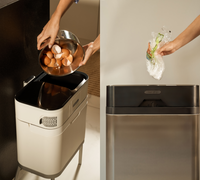
The OC neatly prepares food scraps for composting or municipal collection. It reduces moisture buildup and controls odor — removing the sensory unpleasantness of collecting food scraps. Organic waste stays contained, stable, and non-intrusive until collection day or drop-off.
The OC helps make separating organic waste an easy, sustainable habit. Whether that waste eventually goes into your own composting system or a municipal collection, the environmental value is significant.

Separating food scraps is a small habit with a specific and measurable impact. Most people who want to separate food scraps are stopped by flies, odors, and inconvenience — and that's a solvable problem.
Make organic waste separation stick.
The Organics Collector is built for compact kitchen spaces and handles the two things that make separation feel impractical: moisture and odor.
Shop Organics Collector →