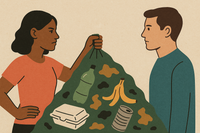
Most conversations about composting start with legitimate questions: Why does it matter? What does it prevent? How much food actually ends up in landfills? A person's motivation to compost was a matter of choice. But a growing number of Americans no longer have that choice.
Is your household now required to separate organic waste?
As of 2026, 12 states have enacted food waste separation mandates. Several more have laws that will take effect through 2027 and beyond. New York City already requires all residents citywide to separate food scraps. And the pattern will only continue. What starts as a commercial requirement for large companies inevitably expands over time to include smaller businesses, institutions, and residential households.
This article maps out the current food waste separation laws across the U.S., including what's already on the books, what's coming, and what it means for households in every state, even those with no current mandate.
of U.S. municipal solid waste sent to landfills is food — the single largest material category, according to the EPA.
states have enacted food waste bans or diversion mandates as of 2026.
landfill diversion target set by California's SB 1383 — the most ambitious residential mandate in the country.
is the year Washington State requires all municipalities over 25,000 residents to offer curbside composting.
Sources: U.S. EPA — Food Material-Specific Data · State Climate Policy Dashboard
Why States Are Focusing on Organic Waste
The main driver is methane. When organic material — such as food scraps, yard waste, and compostable packaging — decomposes in a landfill without oxygen, it produces methane, a greenhouse gas roughly 80 times more potent than CO₂ over a 20-year period. Landfills are the third-largest source of methane emissions in the U.S. Food waste accounts for the largest single material category in U.S. landfills, according to the EPA.
A 2025 report from UC Davis examining state food waste policies noted that most states have not yet aligned their food scrap diversion requirements with federal reduction targets. That gap remains significant.
That said, the policy response has accelerated. According to the State Climate Policy Dashboard, 12 states now have enacted food waste bans or recycling mandates. This is up from just two (Vermont and Massachusetts) a decade ago. The pace of new organic waste recycling laws in 2025 and 2026 alone reflects how quickly climate policy is moving.
A 2024 policy explainer from Climate XChange describes this wave as a deliberate strategy to divert organic waste from landfills, reduce emissions, and redirect nutrients back into the soil through composting and anaerobic digestion.
The structure of most mandates follows the same logic. Regulations begin with high-volume commercial generators. These include large food businesses, hospitals, universities, and stadiums where the impact is greatest. From there, coverage expands to smaller businesses and eventually to residential households.
States With Active Organic Waste Mandates
The following 12 mandatory composting states have enacted food waste bans or food scrap diversion requirements. All data is drawn from the State Climate Policy Dashboard, which tracks passed legislation only.
| State | Year Enacted | Who It Applies To | Key Requirement |
|---|---|---|---|
| Vermont | 2012 | All generators, residential and commercial | Complete landfill ban on food scraps and yard waste. Curbside collection is required. |
| Massachusetts | 2014 | Businesses generating >0.5 tons/week | Organic waste must go to composting or anaerobic digestion. |
| Rhode Island | 2014 | Commercial generators | Food waste diversion is required for qualifying businesses. |
| California | 2016 (SB 1383) | All generators — residential and commercial | 75% organic waste reduction target by 2025, with mandatory composting statewide. |
| New York | 2019 | Commercial generators (phased by volume) | Mandatory organics diversion; threshold lowered from 2 tons to 1 ton/week as of Jan 2026, will drop further to 0.5 tons/week in 2029. Distance to processor expanded to 50 miles. |
| Maryland | 2021 | Commercial generators | Businesses generating 1 ton or more of organic waste per week must divert food waste and submit annual recycling reports, effective January 1, 2026. |
| Washington | 2022 | Businesses (phased thresholds 2024–2026); municipalities by 2027 | Tiered rollout; municipalities >25k residents must offer curbside composting by 2027. |
| New Hampshire | 2023 | Commercial generators | Food waste ban enacted; applies to qualifying businesses. |
| Connecticut | 2024 | Commercial generators | Food waste diversion required for qualifying generators (26+ tons/year); expanded in July 2026 to include K-12 schools within 20 miles of a composting facility. |
| Illinois | 2024 | Commercial generators | Food scrap recycling mandate for larger generators. |
| Maine | 2025 | Commercial and institutional generators | Law enacted June 2025 applies to generators within 20 miles of an organics facility that produce 2+ tons/week. Compliance is required by July 1, 2030. |
| New Jersey | 2026 | Commercial generators (phased rollout) | Law enacted requires commercial generators producing 52+ tons/year to divert to authorized food waste recycling facilities; exemptions for facilities over 25 miles from a recycler. |
Full policy details and legislation for each state: State Climate Policy Dashboard — Food Waste Bans.
States With Pending or Proposed Legislation
The State Climate Policy Dashboard tracks only enacted legislation, not bills in progress. However, several states are actively moving toward organic waste mandates based on publicly available legislative activity and reporting from ReFED's U.S. Food Waste Policy Finder and Climate XChange.
A number of states have active voluntary diversion programs and existing infrastructure that typically precede mandates — but no state has enacted a binding statewide requirement as of this writing. The State Climate Policy Dashboard lists 39 states with no enacted food waste law.
The trajectory is consistent with how previous mandates developed. Massachusetts enacted its commercial food waste ban in 2014 following years of voluntary programs. New York followed in 2019. Connecticut and Illinois both enacted laws in 2024. The gap between early-adopter states and the rest is narrowing.
A toolkit published by the Zero Food Waste Coalition (2023) identifies model legislation frameworks that states can adapt, including graduated threshold approaches, composting infrastructure requirements, and enforcement mechanisms. Several states currently reviewing legislation are drawing directly from this framework.
Reference: Achieving Zero Food Waste — A State Policy Toolkit (Zero Food Waste Coalition, 2023).

What This Means for Households
If you live in one of the 12 enacted states, you may be wondering if the mandate applies to your household. And, if so, what does compliance look like in practice?
For most residential households outside California and Vermont, current mandates target commercial and institutional generators. Homes are not yet directly required to separate organic waste in most states. But this is quickly changing.
Vermont extended its universal ban to residential sources in 2020. California has done the same. New York City went citywide in April 2025, making it the largest U.S. municipality with a mandatory residential composting program, enforceable with fines for property owners who don't comply.
If you live in a state without any current mandate, you may not have to be compliant quite yet, but it helps to be ready. The infrastructure rollout that precedes residential mandates typically happens over 3 to 5 years. Households that build a composting habit now will face no learning curve when the requirement arrives to their state.
But starting and continuing that habit is often the biggest hurdle. People tend to give up on organic waste separation fast — and always for the same reasons: the inevitable odors, pests, and annoyance of having to empty out the compost bin practically daily. Addressing these friction points is what determines whether the habit lasts — whether there's a legal requirement or not.
How To Get Ahead of Your Local Requirements
- Check your state and municipality's current status. Use the ReFED Food Waste Policy Finder or the State Climate Policy Dashboard to verify current requirements in your state. Local municipalities sometimes move ahead of state law. Check city ordinances independently.
- Confirm whether organic collection is available in your area. In states with enacted mandates, municipalities are typically required to provide collection. In other states, check if your waste hauler offers organics pickup or a local drop-off facility exists. The EPA's Food Recovery Hierarchy provides context for prioritizing different diversion methods.
- Establish the indoor collection habit before anything else. The biggest source of non-compliance — for both households that are required to separate and those that want to — is inconsistent indoor collection. A bin that smells, attracts insects, or requires daily emptying gets abandoned. The solution is the right tool, not more motivation.
- Treat the habit as infrastructure, not an event. Behavioral research consistently shows that strong habits form when the physical setup removes friction entirely. The habit doesn't require willpower once the tool handles the hard parts.
- If you're in a state where requirements are expanding, get ahead of the compliance timeline. New York State's threshold drops to 1 ton/week as of 2026, and again to 0.5 tons/week by 2029. Washington's 2027 requirement covers businesses generating as little as 0.25 cubic yards per week — nearly universal in practice. California's AB 660, effective July 2026, standardizes food date labels to reduce preventable waste before it even reaches the bin.

The Organics Collector: Designed for Compliance Without Friction
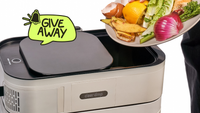
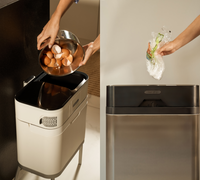
The Organics Collector (OC) is a countertop food scrap collection tool designed for daily indoor use. It is not a composter. It does not process or transform organic material. Instead, it allows you to manage your food scraps cleanly between municipal or curbside pickups.
The Organics Collector is designed to make food scrap collection a breeze. It does this with:
- A carbon filter and fan system that contains odors between pickups. Store your scraps for up to one week without the typical smells.
- A sealed, hands-free lid that closes automatically after each use. That means no insects can get in.
- A large-capacity design that requires no daily maintenance and reduces the need to empty the bin to approximately once or twice per week.
- A compact countertop design that integrates with standard kitchen layouts.
The OC accepts all food scraps, which means no uncertainty about what qualifies and no extra mental energy needed to sort out your scraps.
The OC makes it easy to collect and manage all of your food scraps whether you legally have to now or want to start building this eco-conscious habit. Learn more: Organics Collector — Clear Drop.

Be ready before your city requires it
Twelve states have already enacted organic waste mandates. More are coming. The Organics Collector makes compliance effortless at the household level — today and when your state catches up.
Shop the Organics Collector → Explore Clear Drop →